 5815 Tutt Center Point - Colorado Springs, CO 80922

“They Do WHAT at School?!” Why Your Child Behaves Differently at Preschool Than at Home
If you’ve ever picked your child up from preschool and heard something that made you question whether their teacher had you confused with another family, you’re not alone.
“They cleaned up all their toys.”
Excuse me?
“They ate all their vegetables at lunch.”
My child?
“They put their own coat on.”
You’re telling me the same child who suddenly loses the use of both arms when it’s time to get dressed at home… puts on their own coat here?
And perhaps the biggest shocker of all:
“They were a great listener today!”
WHOSE CHILD ARE WE TALKING ABOUT?!
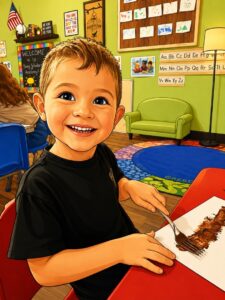 We hear versions of these conversations all the time in early childhood education.
And while it’s funny, there’s actually a really important reason children can seem like completely different little humans at school and at home.
The short answer?
Environment matters.
Preschool Is Extremely Predictable
A good early childhood classroom might look like organized chaos from the outside, but underneath all that playing, painting, singing and movement is a very predictable routine.
Children learn what happens next.
We arrive. We put our things away. We wash our hands. We play. We clean up. We eat. We go outside. We rest.
The exact schedule varies, but the expectations generally don’t.
And young children thrive on knowing what’s coming next.
Teachers also repeat the same expectations over and over—and over and over and over—because repetition is how young children learn.
At home, life naturally isn’t quite as predictable.
Dinner is late because someone worked late. There’s soccer tonight. The dog threw up. Someone can’t find a shoe. Mom needs to answer a phone call. Dad is trying to get three people out the door.
That’s normal life.
But it also means home doesn’t always have the same built-in structure that a classroom does.
Never Underestimate the Power of Other Kids
Want your preschooler to try something?
Sometimes the best strategy is putting them next to six other preschoolers who are already doing it.
Peer modeling is incredibly powerful during early childhood.
When everyone at the table is eating, children are often more willing to try what’s being served.
When everyone starts cleaning up, cleaning up becomes what we do.
When everyone grabs their coat to go outside, suddenly putting on a coat isn’t quite the outrageous request it seemed to be at home that morning.
Children learn constantly by watching other children.
It’s one of the reasons group care can provide learning opportunities that are difficult to recreate anywhere else.
At School, We Know They Can Do It
Here’s another piece parents don’t always get to see.
Sometimes we’re a little more willing to wait.
Your child says:
“I can’t put my shoes on.”
And instead of immediately doing it for them, a teacher might say:
“Give it a try first. I’ll help if you need me.”
And then we wait.
It might take longer.
The shoe might go on the wrong foot.
They might get frustrated.
But eventually…
They do it.
At home, adults are usually trying to get somewhere.
It’s 7:42 in the morning, everyone needs to be out the door, someone hasn’t brushed their teeth and now is absolutely NOT the time for a twelve-minute independent shoe experiment.
So you put the shoes on.
We’ve all been there.
The problem comes when children rarely get the opportunity to struggle with something long enough to discover that they’re actually capable of doing it.
Independence requires practice.
Sometimes teachers simply have more opportunities throughout the day to say:
“I know you can try.”
Expectations Change Behavior
Children are incredibly good at figuring out which expectations exist in which environments.
Think about adults.
You probably behave differently at work than you do sitting on your couch Saturday night.
Children do this too.
They learn very quickly:
At school, I carry my plate to the table.
At school, I put the blocks away when we’re finished.
At school, I wait until it’s my turn.
At school, I carry my own backpack.
It’s not because teachers have some magical power parents haven’t discovered.
It’s because those expectations have been practiced consistently enough that they’ve simply become part of the routine.
And Then… There’s Home
Here’s the part that sometimes gets overlooked.
Your child behaving beautifully all day and then completely falling apart when they get home doesn’t necessarily mean something went wrong at school.
School asks a LOT from little brains.
All day long they’re sharing.
Listening.
Waiting.
Communicating.
Problem-solving.
Transitioning.
Following directions.
Managing disappointment.
Navigating friendships.
Trying new things.
Using self-control.
Learning.
By pickup time, their little battery may be running on 2%.
And then they see you.
Their person.
Their familiar place.
Home.
And suddenly…
THE WRONG CUP IS AN EMERGENCY.
This is often when parents wonder:
“How can their teacher tell me they had an amazing day when they’re completely losing it right now?”
Both things can be true.
Your child may genuinely have had a wonderful day.
And your child may also be completely done holding it together.
So Why Do They Save the Biggest Feelings for Us?
Because home and school serve different purposes.
Preschool gives children opportunities to practice functioning as part of a community.
Home gives them familiarity, connection and a place to decompress.
That doesn’t mean parents should accept every behavior because “they’re comfortable with me.”
Boundaries still matter.
Consistency still matters.
But sometimes understanding why a behavior is happening changes how we respond to it.
A hungry, exhausted four-year-old melting down at 5:30 isn’t necessarily asking for a lecture about making good choices.
Sometimes they need food, connection, predictability and an early bedtime.
Want Some of That Preschool Magic at Home?
You don’t need to turn your house into a classroom.
But you can steal a few things preschool teachers do every day.
Give fewer words.
Young children usually don’t need a five-minute explanation. Give the direction simply and clearly.
Give choices you can live with.
“Do you want to put your shoes on or your jacket first?”
Either answer gets us closer to leaving the house.
Create predictable routines.
If pajamas, teeth, book and bed happen in roughly the same order every night, eventually children know what’s expected without needing twelve reminders.
Let them do things themselves.
Even when it’s slower.
Pouring. Carrying. Cleaning. Dressing. Opening. Zipping. Putting away.
They won’t become independent if they never get to practice independence.
Don’t underestimate what they’re capable of.
This might be our favorite one.
Because sometimes we’ll tell a parent:
“Oh yeah, they do that themselves every day.”
And the look we get back is priceless.
Your Child Isn’t “Better” for Their Teacher
This is probably the biggest misconception we want to clear up.
Your child isn’t choosing to be a “good kid” at school and a “bad kid” at home.
And their teacher hasn’t unlocked some secret parenting code.
They’re responding to two completely different environments.
One has group routines, peer modeling, repeated expectations and lots of opportunities to practice independence.
The other has family relationships, busy schedules, different expectations and the people they love most in the world.
Children need both.
Preschool helps children learn how to function in a community.
Home gives them the foundation they return to.
And somewhere between the two, they’re learning how to become increasingly capable, independent little humans.
So the next time your child’s teacher casually mentions that they cleaned their entire space, put on their own coat, ate something green AND listened beautifully all day…
Don’t worry.
We’re talking about the right kid.
We promise. 😉
Leave a Reply