[email protected]

Young Scholars Academy

Where Children Develop a Love of Learning

  • Home
  • About Us – Our Mission
    • Our Child Care Team
    • Team Leaders
    • Team Member of the Month!
  • Resources
    • Parent Resources
    • Additional Benefits
  • Contact Us
    • Careers at YSA
Location Icon  5815 Tutt Center Point - Colorado Springs, CO 80922
Phone Icon  (719) 522-9099
Book a Tour
  • Events & Updates
  • Programs
    • Infant Program
    • Toddler Program
    • Preschool
    • Prekindergarten
    • Junior Kindergarten
  • School Age Programs
    • Before and After School Program
    • Summer Camp
  • Enrichment Programs
    • Curriculum Ideas For Home | Young Scholars Academy
    • Art Projects
    • American Sign Language
    • Music & Fitness
  • Testimonials
    • Our Kids Speak!
  • Blog

It’s ok to make out of the box decisions

August 25, 2020 by Young Scholars Academy Leave a Comment

This is by far the most personal and vulnerable thing I’ve written in awhile, but I feel that in my position as Parent Connection Coordinator, it’s pretty spot on for what we’re dealing with as parents right now. I’ve worked in Infant A here at Young Scholars Academy for 2 years. Before that I stayed home with my two boys, and before that worked with infants and toddlers for 7 years. Ask me anything about infant feeding, sleep, development, car seats, etc and I either have the answer or I know where to find it. Most of my knowledge base is invested in those topics because they are what I’m passionate about. My boys are 6 and 3 though, so as a mom I’m in uncharted territory. My 6 year old is in 1st grade this year and the entire mess of trying to figure out schooling truly started this past spring when everything shut down and schools were forced to implement a last minute e-learning schedule. I felt it right along with other moms (and dads too!) when the stress of all the decisions came into play. I’ve been stressed along side them. We’ve all seen the memes and posts on Facebook about no decision being the right one or the wrong one, but for our family (and so many others) it was extremely difficult.

My 6 year old has special needs, some of which we’re still in the process of screening and figuring out. These make it very hard for him to process and regulate the flow of sensory input and how his body reacts to those stimuli. The first Zoom meeting we had with his teacher this spring ended about 30 seconds in when she un-muted all the students so everyone could say hi. He slammed the laptop down and ran away with his hands over his ears and needed about 30 minutes to regain his composure and talk about what had happened. We didn’t attend anymore Zoom meetings after that. The other struggles of simply getting him to do the assignments seem to be echoed by so many parents that I actually felt a smidge better. We didn’t know what e-learning was going to look like until kids could return in person, but we knew we didn’t want him in school quite yet. Sensory issues were going to make so many things more challenging and I didn’t want to put that on him or the teachers and staff.

Less than a week before e-learning was to begin for this school year, a schedule was released that included quite a few Zoom meetings everyday, and that set my panic mode and my mom mode into overdrive. I needed to find the best solution for my son and our family. This schedule wasn’t going to work for him with me at work full time, but I also really love my job and didn’t want to have to leave to make this work. Zoom meetings were a nightmare and his ability to work independently has been historically disastrous. It looked like a lose lose situation for quite awhile. I think I must have googled “can you home school and work full time?” 3 or 4 times before it really started to look like a viable option. I know I annoyed my poor co-teacher talking myself from one decision to another, then to yet another. It’s like I felt if I could convince her it was going to work, then it was going to work. Really though, I was trying to convince myself.
We attended back to school day and left even more confused and uncertain and the next day we sat down to talk. Our options were to push forward with e-learning and hope that someone could convince him to do his work and get through the zoom meetings, or I could pull him from school and home school. Ultimately we decided to pull and home school. I found an amazing curriculum for core subjects and have the flexibility to supplement with other subjects like STEM, art and music in ways that I know he’ll enjoy. It’s actually been a huge relief going this route and connecting with many more families who have done the same thing. An amazing bonus is that I still get to come to my amazing job every day.

None of this is to say that I appreciate the teachers, staff and administrators any less. This entire situation has been insane and everyone is getting through it the best way they know how. Ultimately though, giving myself the permission to make the hard decisions that are in the best interest of my son was amazing. There isn’t just one right way to educate children. One child may learn a different way and won’t fit in to one mold. While we prove this everyday at YSA, once the kiddos are older it’s hard to see there are other paths. A very big piece of the puzzle is having the support to carry out those plans and to figure things out. So, while things are still uncertain and hazy going forward, know that YOU are going to be the best one to make decisions about what to do for your family. It’s so true that there isn’t a right or wrong answer when it comes to school right now, but supporting each other and our kids is the first step.

Thank you for reading.

Ms. Amy
Infant Nursery Supervisor
Parent Connection Coordinator

Filed Under: Activities

Summer Scavenger Hunt

July 2, 2020 by Young Scholars Academy Leave a Comment

While trying to think of ways to keep your preschooler engaged during the summer, consider planning a summer scavenger hunt that could be done in your neighborhood! This could be accomplished all in one weekend walk or spread throughout many walks over the month. As a family, work together to create a one of a kind list. Get materials to create your list, such as poster board or paper, markers, and stickers to decorate. Depending on the age of your kiddo, allow them to help as much as possible. The more they are involved with creating the scavenger hunt list, the more they will want to do it!

Some of the items on the list could be things youd like your kiddo to work on that you would see in your neighborhood such as numbers, colors, shapes, and animals. For an extra touch, ours also is going to include random acts of kindness! I think it is a great way to have fun with the kiddos and spread some joy within our neighborhood. To start, I explained what a scavenger hunt was to my preschooler. We then talked about the different things he thought he would like to add to try and find within our neighborhood. You may even need to explain what a neighborhood is to your kiddo if they do not know or need a refresher. As we began to explore colors, numbers, shapes, and animals to find on our hunt, the list grew pretty quickly! He was able to come up with some neat things to try and find all on his own! One of the items he came up with is trying to find a big dinosaur! Maybe he will! 😊

I then told him I wanted to also include kind acts which we could add to our list to spread kindness in our neighborhood. Some of the acts of kindness we came up with include: Draw 3 chalk pictures or kind words in front of a house, Leave a happy picture/note on someone’s door, pick up 5 or more pieces of trash (gloves and sack needed that day), find a neighbor walking and give them a compliment, share some chalk with neighbor kiddos, and say hello to 3 people on the walk. He was thrilled to add these to the hunt and I was excited he was so involved with coming up with the ideas to create the entire list.

By having the conversation of kind things we could do in our neighborhood, it led to a bigger conversation of how to be kind in daily life to others! The activity of forming this scavenger hunt really kept my preschooler engaged and eager to start! So we started right away!

He was so excited to go on his hunt, we picked a few things off the list to search for on our first walk. While we were out we got to talk to new neighbors, met a few new kiddos, and overall had a great time! I am excited to see how much fun he will have with this throughout the rest of the summer and how proud he will be when it is all finished!

Ms. Whitney

Lead Pre-Kindergarten Teacher
Curriculum Coordinator

Filed Under: Activities

4 Activities that Promote Social and Emotional Learning for Kids

June 20, 2020 by Young Scholars Academy Leave a Comment

There is no doubt that children learn to consume different information very quickly on a day-to-day basis. While cognitive and fine motor skills are important in improving a child’s growth, social and emotional learning (SEL) plays a critical role in how a child copes with feelings, peers, and resolving conflicts. Recognizing and taking the initiative to nurture a child’s social and emotional skills can help better equip them for today’s society. Here are few activities that can help improve your child’s social and emotional learning: 

Checking in With Your Child

Start the day off by checking in with your child. It could be as simple as asking them how they are feeling.

Using a “feelings board” can be very useful when interacting with young children, as they are able to point to an image that best reflects their mood.

Giving big hugs and/or warm greetings can change their mood from one that is dull to a more joyful one.

Make it a habit to start the day off by checking in with your child and identifying what their mood is like for that day.  

Group Activities/Games  

Make activities group or partner related. Working with others helps children develop their social and emotional learning as they will have the opportunity to talk with each other, listen to each other, and interact with each other throughout the activity.

Working with a partner improves a child’s learning ability by helping them build better social connections and collaborations. Here are three social and emotional learning games that require group participation.

  • Ring Around the Rosie 

Children will hold hands and stand around in a circle. While singing the song ‘ring around the rosie’, the children move around the circle. When the song ends, ‘we all fall down’, the children fall to the ground.

  • Bouncing Ball and Boxes 

While everyone is collectively holding a very large box, they will roll the ball around inside trying to keep it in the center. By working together and holding the box steady, they will be able to balance the ball in the right direction. 

  • Large Group Murals 

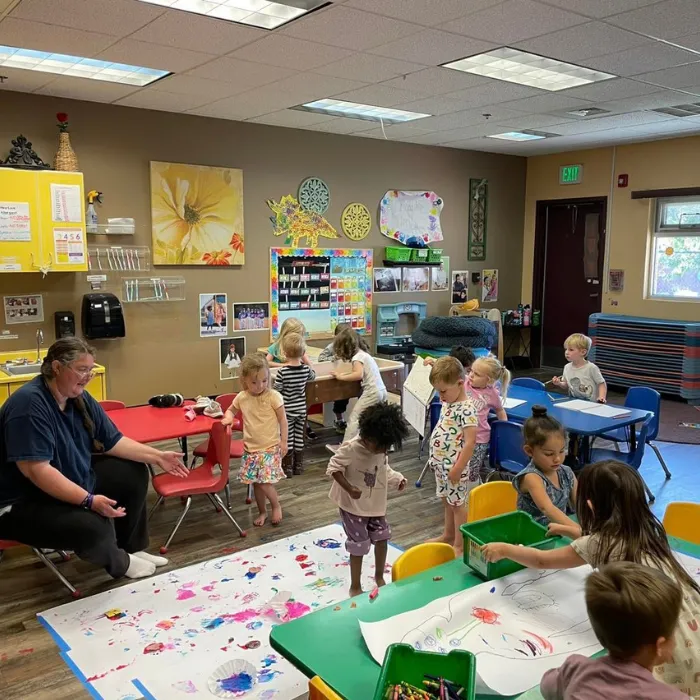
Children work together to either paint or color in the mural to have a complete picture. Children will be interacting and communicating about each space that needs to be colored. They make group decisions about such things as which side of the mural needs more or less color. As children work together to complete the mural, they build a sense of accomplishment as well as tap into more social and emotional learning. 

Breathing Exercise 

While recognizing the importance of a child’s social and emotional skill, it is also imperative to know how to handle the lack thereof. Children at times find it hard to express themselves. 

Coping mechanisms, such as breathing and stretching exercises, can help in releasing emotional stressors. These exercises help improve children’s physical and mental health as well as managing anxiety, emotions, and/or self-esteem.

Breathing and stretching exercises can be done at any time of the day and can be an interactive practice between children and parents. You can help your child with social and emotional learning by taking part and encouraging your child constantly.  

Story Time

Using this time to interact with children can be a useful tool, allowing a child to express their thoughts and feelings about a story. This is an opportunity to ask children questions and listen to their thoughts.

Reading aloud is a perfect tool for exploring a child’s social and emotional learning skills. Choose a book that is interactive and developmentally appropriate for children. Have children help pick out books.

If the book has illustrations that include vehicles and/or animals, have children make the sounds or act out how the animals would. Make it fun so that they will want to talk about the book with you or their peers. 

Children are born to understand and develop a sense of themselves and of the world around them. With social and emotional learning, they are better suited and equipped to handle change, make genuine connections, and demonstrate social and self-awareness.

These are significant benefits in assisting the makeup of a child’s entire future. Providing an outlet for a child to develop these skills can be impactful. They will feel good about themselves and feel confident enough to interact with others. 

These activities are here for you to try and take part in the social and emotional learning resources that are available to the betterment of your child.

Young Scholars Academy provides a positive environment where your child can improve and make progress in their social and emotional learning in the early stages of life. To learn more about Young Scholars Academy and what we have to offer, feel free to call or visit our website at youngscholarsacademy.com  .


Filed Under: Activities

Caring for the Earth

May 6, 2020 by Young Scholars Academy Leave a Comment

I’m an Air Force brat. I spent most of my formative years in The Netherlands and Germany and we had this channel called AFN (Armed Forces Network) where they featured these cool PSA commercials. One in particular has stuck with me to this day. It shows a child turning on the water and starting to brush his teeth and pans out showing a fish in a pond near the house. The water in the pond is slowly going down the longer the water faucet is on. The fish grabs a phone and calls the child, asking him to turn off the water, right before the fish runs out of water. Simple right? The lesson is easy; turn off the water while brushing your teeth and you’ll save water and help the fish. I’m 32 years old and that PSA is burned into my brain.

This is really how easy it can be to teach children about conservation, sustainability, and even recycling. It couldn’t be more important now, with everyone being stuck at home and worrying about necessities such as toilet paper, disinfectant wipes, and paper towels. I had so much planned for April because Earth Day is this month, but had to get crafty and focus inward on how we can start at home. Bring your kiddos in on a plan to help the planet. Clean up trash outside, try to reduce waste within your household, and make decisions that will help the earth, not hurt.

One thing I feel like I have to remind my boys about a lot is turning off the lights. They’re 3 and 6 so it’s not a top priority when they leave a room. Coming up with fun rhymes or sayings like, “it’s alright, turn off the light” are super simple and easy for young children to remember. It can be difficult to explain to a young child why we need to even worry about it, so making the Earth into a being rather than an object can be helpful. For example, we need to turn off the lights so we don’t use up all of the Earth’s energy and make her tired.

Teaching sustainability can be really fun if you go at it the right way. Our 6 year old had been using so much toilet paper that he was clogging the toilet. I mean, this is a problem at any time, but even more so now with the toilet paper shortage! We had to put a stop to that. Putting lines of tape under the toilet paper roll to let them know where to stop for a #1 and #2 puts them in control. They’re given the boundary and it’s easy to follow. (Plus, they’re counting and measuring!) Even further than that, your child can help find ways to ditch disposable products and find ones you can reuse. Some examples of this we have in my house are cloth diapers, cloth wipes, reusable sandwich bags, stainless steel straws, “unpaper” towels, and reusable shopping bags. Not every option will work for every family, but you’d be surprised what children can come up with if you ask them.

Teaching recycling is probably my favorite. It’s so much more than that because it makes it into a sorting game, there’s patterning, matching, and a massive creative side. The fun activity in our house lately is making Minecraft objects. Our 6 year old draws and colors on graph paper, we glue it to cardboard from the inevitable Amazon box we have, and he has a cool new toy to play with. It puts that cardboard back to use instead of right back in the trash. So many things in your house can be used that way. An empty disinfectant wipes bottle and some ball pit balls create and awesome fine motor activity for infants and toddlers. A paper towel roll taped to the wall creates a cool tunnel for a matchbox car or even straws. Cut a slit in the lid of just about any plastic container to drop playing cards in. Kids even love taking full size grocery items and using them in the play kitchens. You name it, macaroni and cheese boxes, empty spice bottles, plastic condiment bottles.

The point is, there is so much we can do by modeling and teaching our children to love and care for the Earth. Earth Day is April 22nd, so I challenge you to find something new to do as a family, no matter how small or crazy, to give back to the Earth even beyond Earth Day.

-Ms. Amy
Infant Nursery Supervisor
Parent Connection Coordinator

Filed Under: Activities

Black History Month In Preschool

February 20, 2020 by Young Scholars Academy Leave a Comment

Putting new ideas in front of our children can be scary, but why are we afraid of diversity and seeing other’s points of view past and present?

This February I challenge each of you to teach your children some history; specifically, Black History. From this I hope that you feel like expanding your children’s (and possibly you own) minds to be open to learning about many different cultures, races/ethnicities, and ways of life.

It is easy to think that teaching history to children younger than five years old is way over their heads, but it’s not. Just like all concepts you find ways to teach your children in ways that they will understand; same thing applies here.

The best way to start off would be by reading some age appropriate books; that will give you an idea of where to start, some vocabulary to use, and figure out what you want to focus on. Reading a book first will give children visuals; which most need because they have not learned any other ways of learning yet. They need the visuals and hands on learning. Which is not what you think of when you think of teaching history. You’re going to have to stretch out of your box. Buy some of these books and music to make a part of your permanent collections. Here are some fun ways to experience Black History and diversity:

Crank up some tunes by:

  • Michael Jackson
  • Stevie wonder
  • Ray Charles
  • Beyoncé
  • Whitney Houston

Talk about famous icons like:

  • Harriet Tubman
  • Martin Luther King Jr.
  • The Obamas

A couple of great books and authors for young children:

  • Vashti Harrison has written Dream Big Little One, Little Legends, and Little Dreamers
  • All the Colors We Are by Kate Kissinger
  • Black is Brown is Tan by Arnold Adoff
  • How my Parents Learned to Eat by Ina R. Friedman

While having these experiences and learning allow your children to ask any questions that they have and give them answers. Explain how people were once separated from one another by the color of their skin. Tell them about the people that had the courage to stand up and say it was not fair. How strong women and men have fought hate to make equal rights for all people. The more you open your hearts to all people into your homes the less drastic conversations will have to be about diversity. Making it a normal part of your daily lives will grow kind and loving adults in the future.

Filed Under: Activities

  • « Previous Page
  • 1
  • …
  • 14
  • 15
  • 16
  • 17
  • 18
  • …
  • 22
  • Next Page »

CHECK AVAILABILITY

Photo of Best Childcare School

Young Scholars Academy
5815 Tutt Center Point
Colorado Springs, CO 80922
(719) 626-9650
Mon - Fri 6:00am - 6:00pm

DRIVING DIRECTIONS

Follow Us

Summer Camp Signup!
Programs
Review Us Online

Categories

  • Activities
  • After School
  • Art Projects
  • Calendar
  • Events
  • Family Tips
  • General Updates
  • Health & Wellness
  • Holidays
  • Newsletters
  • Pre-Kindergarten
  • Preschool
  • Programs & Curriculum
  • Email Login
  • Disclosures
  • Site Map
  • No Joke Childcare
  • Admin Login
  • Contact Us
  • Updates Simplified

5815 Tutt Center Point Colorado Springs, CO 80922, (719)522-9099

Copyright 2025 Young Scholars Academy All Rights Reserved.

Email Login| Site Map| No Joke Marketing For Childcare| Contact Us| Updates Simplified