[email protected]

Young Scholars Academy

Where Children Develop a Love of Learning

  • Home
  • About Us – Our Mission
    • Our Child Care Team
    • Team Leaders
    • Team Member of the Month!
  • Resources
    • Parent Resources
    • Additional Benefits
  • Contact Us
    • Careers at YSA
Location Icon  5815 Tutt Center Point - Colorado Springs, CO 80922
Phone Icon  (719) 522-9099
Book a Tour
  • Events & Updates
  • Programs
    • Infant Program
    • Toddler Program
    • Preschool
    • Prekindergarten
    • Junior Kindergarten
  • School Age Programs
    • Before and After School Program
    • Summer Camp
  • Enrichment Programs
    • Curriculum Ideas For Home | Young Scholars Academy
    • Art Projects
    • American Sign Language
    • Music & Fitness
  • Testimonials
    • Our Kids Speak!
  • Blog

Tour Checklist: What To Look For On A Preschool Visit In Colorado Springs

October 3, 2025 by Young Scholars Academy Leave a Comment

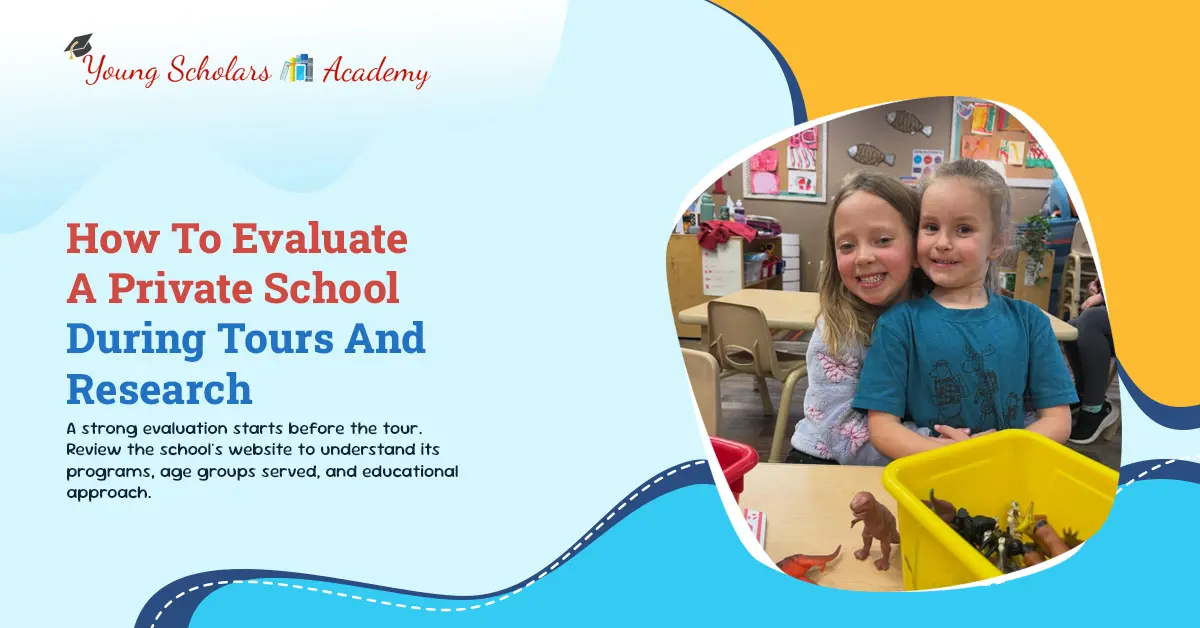
best preschool tour checklist in Colorado SpringsThe best preschool tour checklist in Colorado Springs helps families confidently evaluate quality, safety, and developmental fit. During a visit, observe secure entry procedures, cleanliness, and well-maintained classrooms. Review teacher qualifications, staff-to-child ratios, and evidence of warm, responsive interactions. Ask about curriculum goals, daily schedules, and how play, literacy, math, and science are integrated with social-emotional learning. 

Note outdoor spaces, gross-motor opportunities, and materials that support exploration. Confirm licensing, accreditation, health policies, and allergy and medication procedures. Learn how the school communicates with families, supports diverse learners, and tracks progress. Align these findings with your child’s needs and your family’s priorities.

Preschool Visit Questions for Parents: Admissions, Philosophy, and Daily Routine

preschool visit questions for parents

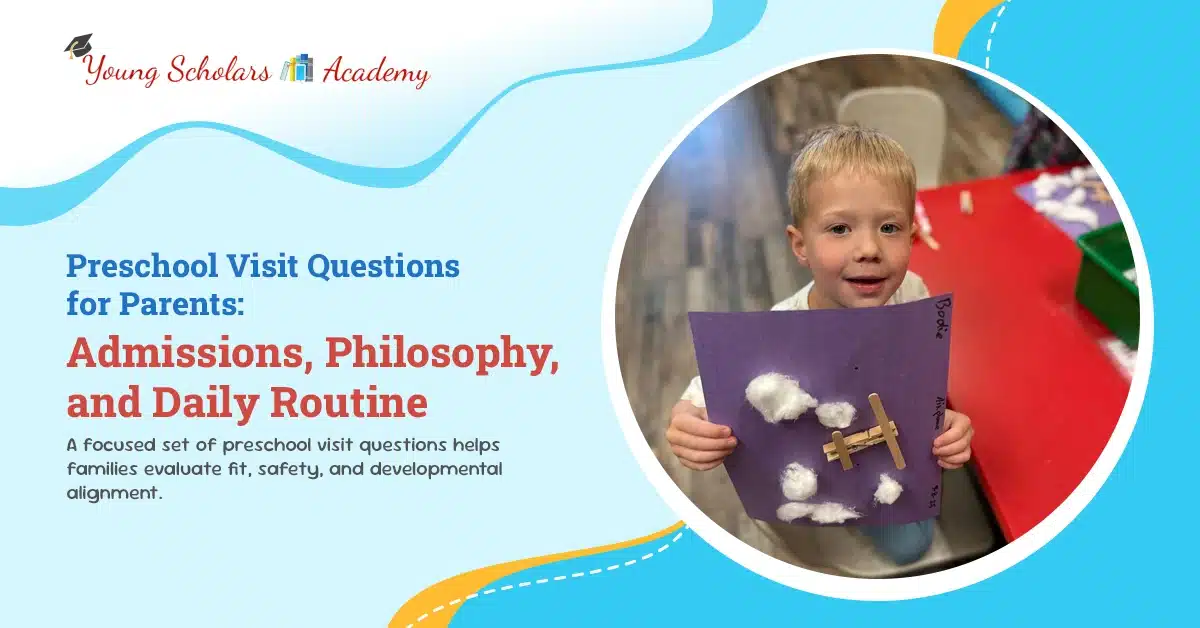
A focused set of preschool visit questions helps families evaluate fit, safety, and developmental alignment. Use the guide below to confirm how enrollment works, teaching supports growth, and the daily flow promotes engagement and calm.

Admissions and Enrollment Policies

Clarify timelines, availability, and requirements, then verify how communication and documentation are handled. Request transparent tuition details and confirm schedule options that match family needs.

Ask:

  • Application window, age cutoffs, and start-date flexibility
  • Waitlist priorities, update frequency, and placement process
  • Tuition, deposits, refunds, and financial assistance
  • Required records (immunizations, forms, residency) and deadlines

Educational Philosophy and Learning Approach

Ensure the philosophy connects play-based learning with literacy, math, science, arts, and social-emotional growth. Confirm how teachers differentiate instruction and document progress.

Ask:

  • Curriculum framework and yearlong scope and sequence
  • Examples of child-led inquiry and teacher-guided lessons
  • Assessment tools (portfolios, checklists, observations) and frequency
  • Family conferences, progress reports, and goal setting

Daily Routine, Transitions, and Classroom Flow

Predictable routines support security and attention while allowing flexible responses to children’s needs. Review a sample schedule and observe transitions, movement, and outdoor play.

Ask:

  • Balance of whole-group, small-group, and individual learning
  • Visual schedules, transition cues, and calm-down spaces
  • Snack, meal, and nap procedures and hygiene practices
  • Integration of movement, music, and outdoor time

Staffing, Ratios, and Family Communication

Qualified, consistent staffing underpins safety and learning. Verify ratios, credentials, professional development, and understand how the school partners with families.

Ask:

  • Staff-to-child ratios, class sizes, and room coverage
  • Teacher education, training in behavior guidance, and onboarding
  • Background checks, supervision policies, and substitute plans
  • Daily updates, messaging platforms, conferences, and monthly newsletters

Document answers, compare them across schools, and prioritize alignment with your child’s temperament, interests, and support needs. Use your observations to confirm that stated policies match daily practice.

What to Inspect on a Preschool Facility: Safety, Cleanliness, and Maintenance

what to inspect on preschool facility

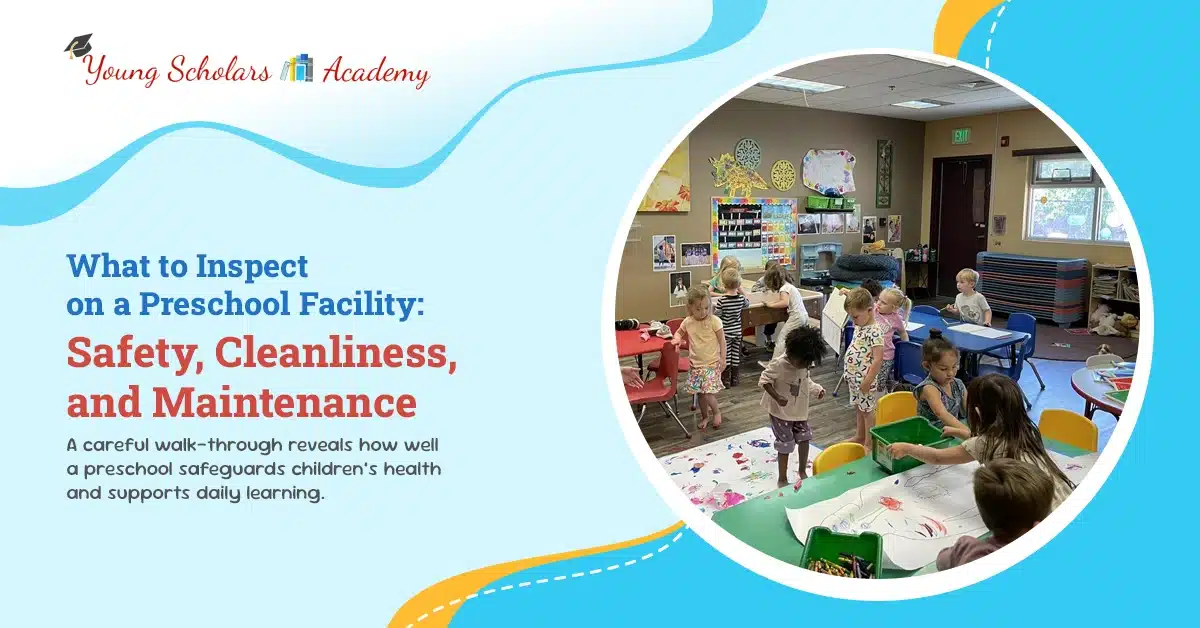
A careful walk-through reveals how well a preschool safeguards children’s health and supports daily learning. Use the points below to verify that safety, hygiene, and upkeep are consistent in every area you tour.

Entry Security and Emergency Readiness

Confirm that building access and crisis procedures are clear and consistently enforced.

Inspect:

  • Controlled entry: secure doors, visitor sign-in, ID checks
  • Supervision: sightlines from office to entrance, staff coverage at peak times
  • Safety plans: posted evacuation routes, drill logs, first-aid kits, AED availability
  • Incident documentation: injury and illness logs, parent notification procedures

Classroom Hygiene and Organization

Clean, orderly rooms reduce illness and promote focus.

Inspect:

  • Cleanliness: wiped surfaces, sanitized toys, labeled bins for soiled items
  • Organization: labeled shelves, uncluttered floors, safe storage of chemicals
  • Ventilation and lighting: fresh air movement, natural light, comfortable temperatures
  • Maintenance: intact flooring, stable furniture, no peeling paint or tripping hazards

Restrooms, Diapering, and Handwashing

Hygiene routines should be visible and easy for children to follow.

Inspect:

  • Facilities: child-height sinks and toilets, stocked soap, and paper towels
  • Diapering: designated station with sanitizer, disposable liners, and covered trash
  • Procedures: posted handwashing steps, staff glove use, and cleaning schedules
  • Odor and moisture control: dry floors, prompt cleanup of spills

Food Areas and Allergen Controls

Meal spaces must meet sanitation standards and protect children with allergies.

Inspect:

  • Surfaces: sanitized tables before and after meals, separate food prep area
  • Storage: labeled containers, proper refrigeration, temperature logs if applicable
  • Allergen safety: posted allergy lists, clear serving protocols, separate utensils
  • Pest prevention: sealed containers, routine inspections, no evidence of pests

Outdoor Playgrounds and Building Systems

Safe play and reliable systems support daily operations.

Inspect:

  • Playground: resilient surfacing, secure fencing, age-appropriate equipment, shade
  • Checks: equipment inspection logs, repaired wear points, clear fall zones
  • Systems: functioning HVAC, carbon monoxide, and smoke detectors with test records
  • Housekeeping: tidy maintenance closets, accessible fire extinguishers, clutter-free exits

Use your notes to compare facilities and confirm that written policies align with daily practice. Consistent cleanliness, proactive maintenance, and visible safety routines indicate reliable care.

Choosing Preschool Classroom Observation Tips: Interactions, Engagement, and Materials

choosing preschool classroom observation tips

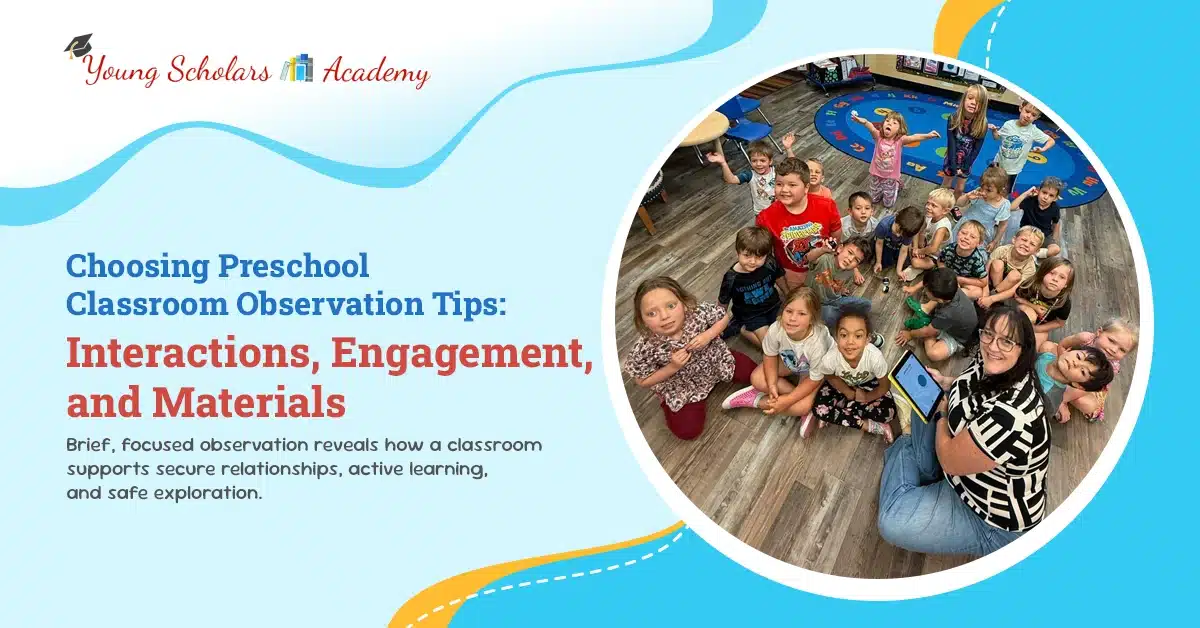
Brief, focused observation reveals how a classroom supports secure relationships, active learning, and safe exploration. Use the points below to assess daily practice and alignment with your child’s needs.

Teacher–Child Interactions

Warm, responsive interactions foster trust and learning.

Observe:

  • Teachers at children’s eye level, using calm, specific language.
  • Prompt comfort and coaching during conflicts or frustration.
  • Open-ended questions that invite thinking and vocabulary growth.
  • Balanced attention across the group, including quieter children.

Student Engagement and Peer Collaboration

Sustained attention signals effective instruction and routines.

Observe:

  • Children choose tasks with purpose and return to finish work.
  • Small-group instruction that rotates and keeps wait time low.
  • Peers share materials, negotiate roles, and take turns.
  • Visual schedules and cues that help children move independently.

Learning Centers and Materials Quality

Thoughtful environments support inquiry and skill building.

Check:

  • Clearly labeled centers (literacy, math, science, art, dramatic play).
  • Open-ended, durable materials that invite multiple uses.
  • Scaffolds for diverse learners: picture cues, adapted tools, varied levels.
  • Accessible storage that promotes independence and cleanup routines.

Transitions, Behavior Support, and Classroom Climate

Predictable structures reduce stress and promote self-regulation.

Look for:

  • Short, well-signaled transitions with songs, timers, or visuals.
  • Calm-down spaces and sensory tools are available without stigma.
  • Positive behavior language, explicit expectations, and quick redirection.
  • Smooth pacing that balances movement, quiet work, and outdoor time.

Documentation, Assessment, and Family Partnership

Clear communication connects daily learning to long-term goals.

Review:

  • Samples of observation notes, portfolios, or checklists.
  • Displayed work with learning objectives, not just decoration.
  • Regular progress updates and opportunities for goal setting.
  • Inclusive practices for bilingual families and children with support plans.

Use concise notes to compare classrooms across visits. Prioritize settings where caring interactions, purposeful engagement, and well-designed materials consistently support growth and well-being.

Curriculum, Assessment, and Kindergarten Readiness

A strong preschool program links daily play with explicit skill building and clear goals for school entry. This section outlines how a coherent curriculum, intentional assessment, and family partnership work together to support the whole child and ensure a confident transition to kindergarten.

Curriculum Framework and Learning Domains

A developmentally appropriate framework should integrate play with purposeful instruction across key areas.

Look for:

  • A scope and sequence covering literacy, math, science, social studies, and the arts.
  • Embedded social-emotional learning, executive function, and self-help skills.
  • Alignment with state early learning guidelines and kindergarten expectations.
  • Culturally responsive content that reflects children’s experiences.

Instructional Practices and Differentiation

Effective teaching adapts to varied readiness levels while preserving predictable routines.

Observe:

  • Brief modeling followed by hands-on, center-based practice.
  • Open-ended materials that offer multiple entry points and challenge levels.
  • Small-group rotations to reduce wait time and target specific skills.
  • Scaffolds for multilingual learners and children with individualized supports.

Assessment and Progress Monitoring

Assessment should be ongoing, observational, and directly inform instruction.

Ask about:

  • Documentation (anecdotal notes, portfolios, checklists, work samples).
  • Screening tools are used sparingly to track key benchmarks without over-testing.
  • Data reviews that adjust grouping, interventions, and enrichment.
  • Clear family reports that highlight strengths and next steps.

Family Communication and Goal Setting

Families are essential partners in readiness.

Expect:

  • Regular updates with specific strategies for home practice.
  • Conferences that include goal setting, progress review, and follow-up plans.
  • Transparent behavior support and consistent home–school routines.
  • Translation or interpreter access when needed.

Readiness Indicators and Transition Support

Kindergarten readiness reflects a whole-child profile, not a single score.

Indicators to review:

  • Social-emotional: manages feelings, follows routines, collaborates with peers.
  • Language and literacy: listens, speaks in sentences, shows print awareness.
  • Math and cognition: counts, compares, recognizes patterns, solves problems.
  • Physical development: fine-motor control, self-care, stamina for group learning.

Transition practices:

  • Coordination with receiving schools, record sharing (with consent), and teacher conversations.
  • Classroom visits, family workshops, and summer readiness activities.
  • Individualized plans for gradual entry or additional supports.

A balanced program uses curriculum to guide experiences, assessment to shape teaching, and partnership with families to ensure children enter kindergarten prepared and confident.

Conclusion

Choosing a preschool is a decision shaped by clear information and careful observation. A strong program demonstrates consistent safety practices, hygienic environments, and responsive maintenance across the facility. In classrooms, warm interactions, purposeful engagement, and accessible materials show how children are supported daily. A coherent curriculum, ongoing assessment, and thoughtful family partnership connect daily experiences to long-term growth and kindergarten readiness. Use your notes from tours to compare policies with practice, confirm alignment with your child’s needs, and prioritize programs that uphold quality in every detail.

Ready to take the next step? Schedule a tour or request more information: (719) 522-9099, https://youngscholarsacademycolorado.com/contact-us/.

 

Filed Under: Activities, Preschool, Programs & Curriculum Tagged With: best preschool tour checklist in Colorado Springs, choosing preschool classroom observation tips, preschool visit questions for parents, what to inspect on preschool facility

5 Smart Reasons Parents Choose Top Daycares in Colorado Springs

May 15, 2025 by Young Scholars Academy Leave a Comment

Why choose top daycares Colorado Springs? For many families, selecting a high-quality childcare provider influences a child’s early development and long-term success. In Colorado Springs, top-rated daycares offer more than basic supervision—they provide structured learning environments, professional staff, and nurturing care supporting each child’s growth. Parents value daycares, prioritizing safety, developmental milestones, and strong communication between educators and families.

These institutions foster cognitive, emotional, and social development through curriculum-based learning and personalized attention. Choosing a leading daycare ensures that children are supported by experienced professionals in an environment that promotes educational readiness and emotional well-being.

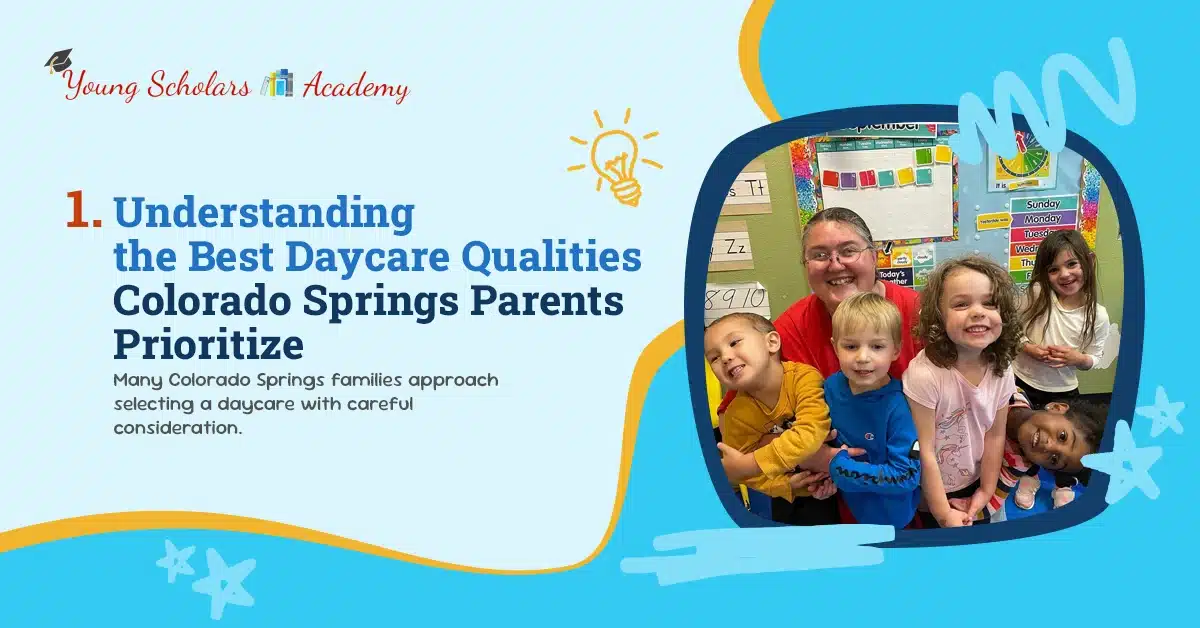
1. Understanding the Best Daycare Qualities Colorado Springs Parents Prioritize

Best Daycare Qualities Colorado Springs

Many Colorado Springs families approach selecting a daycare with careful consideration. Parents look for centers that meet high care, safety, and education standards to ensure their child’s well-being and development. The following areas highlight the best daycare qualities Colorado Springs families consistently value.

A Safe and Supportive Environment

Safety remains a main priority to any parent choosing a childcare provider. High-quality daycares implement strong protocols that protect children while encouraging a nurturing atmosphere.

  • Secure access systems: Only authorized individuals are allowed entry to the facility.
  • Emergency preparedness: Staff are trained to handle fire drills, lockdowns, and medical situations.
  • Cleanliness standards: Classrooms, toys, and surfaces are sanitized regularly to prevent illness.

Parents feel confident when daycares demonstrate a energetic approach to health and safety, supported by clear procedures and consistent staff awareness.

Skilled and Attentive Staff

Families emphasize the qualifications and professionalism of the educators and caregivers. Staff members must guide children through each developmental stage with care and expertise.

  • Early childhood education credentials: Teachers have the training to support age-specific needs.
  • Low staff turnover: Long-term employees foster stability and stronger relationships.
  • Ongoing professional development: Staff regularly attend workshops and training to stay current.

The presence of a well-trained and committed team reassures parents that their child is in capable hands each day.

Age-Appropriate Learning and Activities

Parents want daycares that stimulate growth through developmentally appropriate instruction. A structured but flexible curriculum is essential to foster language, motor development, and social interaction skills.

  • Play-based curriculum: Learning is encouraged through creative exploration and sensory play.
  • Individualized lesson plans: Activities are adapted to meet each child’s needs.
  • Balanced daily schedules: Children experience a mix of learning, play, and rest.

These learning opportunities promote curiosity and lay the foundation for academic readiness.

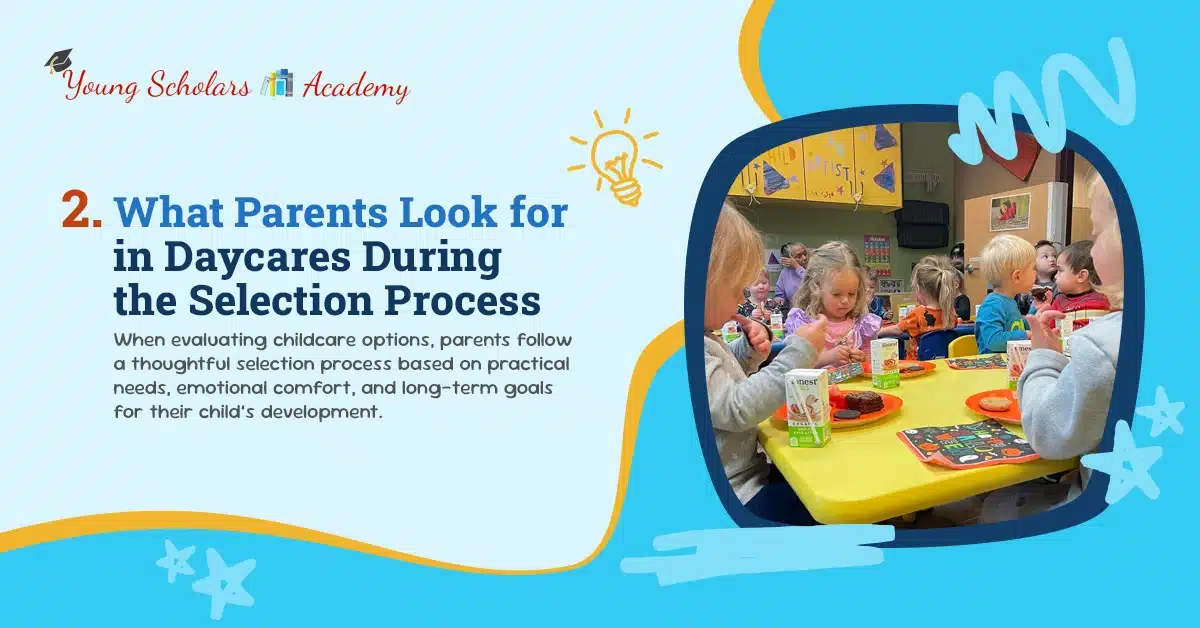
2. What Parents Look for in Daycares During the Selection Process

What Parents Look for in Daycares

When evaluating childcare options, parents follow a thoughtful selection process based on practical needs, emotional comfort, and long-term goals for their child’s development. Choosing a daycare involves more than convenience—it reflects a family’s values, expectations, and desire for high-quality early learning.

Communication and Transparency

Parents want to feel informed and involved in their child’s day-to-day experiences. Open lines of communication build trust and allow families to partner with staff in supporting their child’s growth.

  • Daily reports and updates: Parents receive summaries of meals, naps, activities, and behavior.
  • Parent-teacher conferences: Scheduled meetings help families stay aligned with developmental goals.
  • Open-door policies: Families are welcome to visit or observe, reinforcing transparency.

Consistent communication creates a sense of reassurance, helping families feel connected to their child’s learning environment.

Flexible and Reliable Scheduling

Working parents often require dependable scheduling options that align with their professional commitments. Flexibility, combined with reliability, is an essential feature of any high-quality daycare.

  • Extended hours: Accommodating early drop-off and late pick-up needs.
  • Clear holiday and closure policies: Providing advance notice and consistency.
  • Reliable staff attendance: Ensuring continuity of care throughout the week.

Families prioritize centers that demonstrate respect for time and maintain dependable routines.

Emotional and Social Environment

The atmosphere of the daycare must promote positive social interactions and emotional growth. Parents seek centers where children can express themselves and build healthy relationships.

  • Warm and welcoming classrooms: Spaces designed to feel safe and inclusive.
  • Positive behavior guidance: Encouraging empathy, cooperation, and self-regulation.
  • Strong peer engagement: Fostering friendships and group learning activities.

A supportive emotional setting allows children to thrive and equips them with essential social skills.

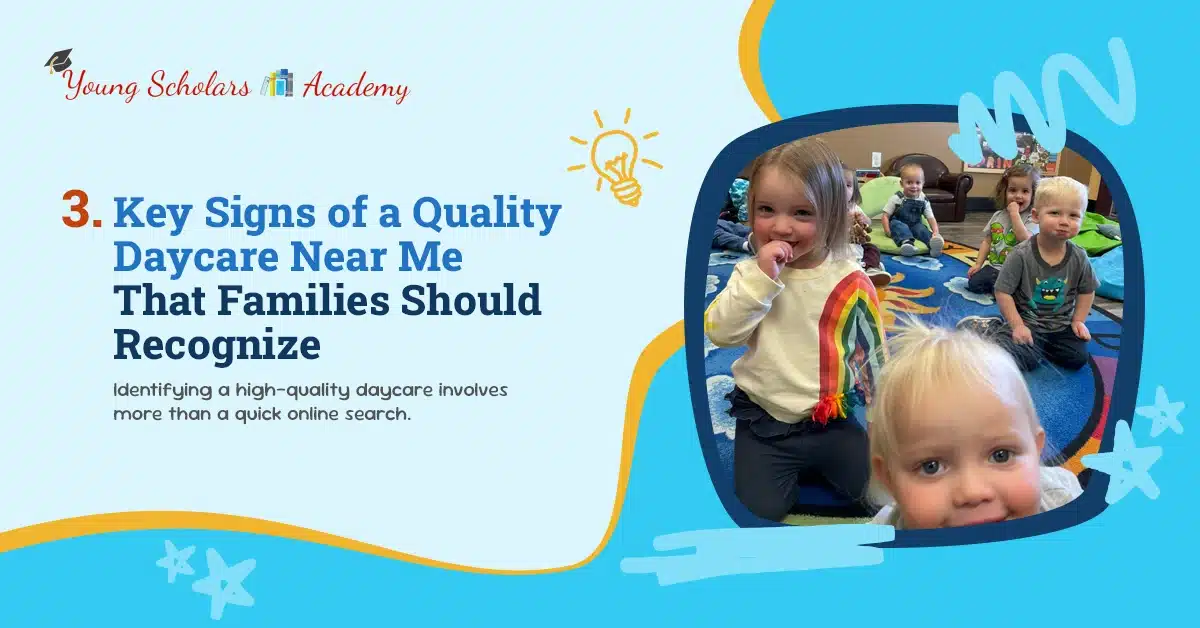
3. Key Signs of a Quality Daycare Near Me That Families Should Recognize

Signs of a Quality Daycare Near Me

Identifying a high-quality daycare involves more than a quick online search. Families looking for a dependable and enriching environment must evaluate specific indicators that reflect professional standards, developmental support, and child-centered care. The following signs help parents recognize a quality daycare near them.

Verified Credentials and Accreditation

A daycare’s certifications and credentials demonstrate its commitment to excellence and compliance with regulatory standards. Accreditation also shows that the center voluntarily meets higher benchmarks of care and education.

  • State licensing: Compliance with required health, safety, and staffing regulations.
  • NAEYC or similar accreditation: Recognition for meeting national early childhood education standards.
  • CPR and first-aid certification: Staff are trained to respond to emergencies.

These credentials indicate that the daycare values safety, accountability, and continuous improvement.

Positive Classroom Environment

A well-maintained, organized, and welcoming classroom encourages active participation and exploration. The physical environment reflects the program’s approach to child development.

  • Clean and organized spaces: Materials are accessible, and environments are free from hazards.
  • Child-centered learning areas: Classrooms are divided into reading, play, and hands-on learning zones.
  • Age-appropriate materials: Toys and tools are designed to match developmental stages.

A quality setting supports comfort, curiosity, and engagement throughout the day.

Professional and Engaged Staff

Caregivers and educators are vital in the quality of daycare. Families notice when staff are attentive, enthusiastic, and well-prepared.

  • Warm interactions with children: Staff communicate respectfully and encourage participation.
  • Observation-based planning: Activities are based on the needs and interests of the children.
  • Consistent staffing: Familiar caregivers build trust and routine.

These elements demonstrate that the daycare values strong relationships and a responsive approach to care.

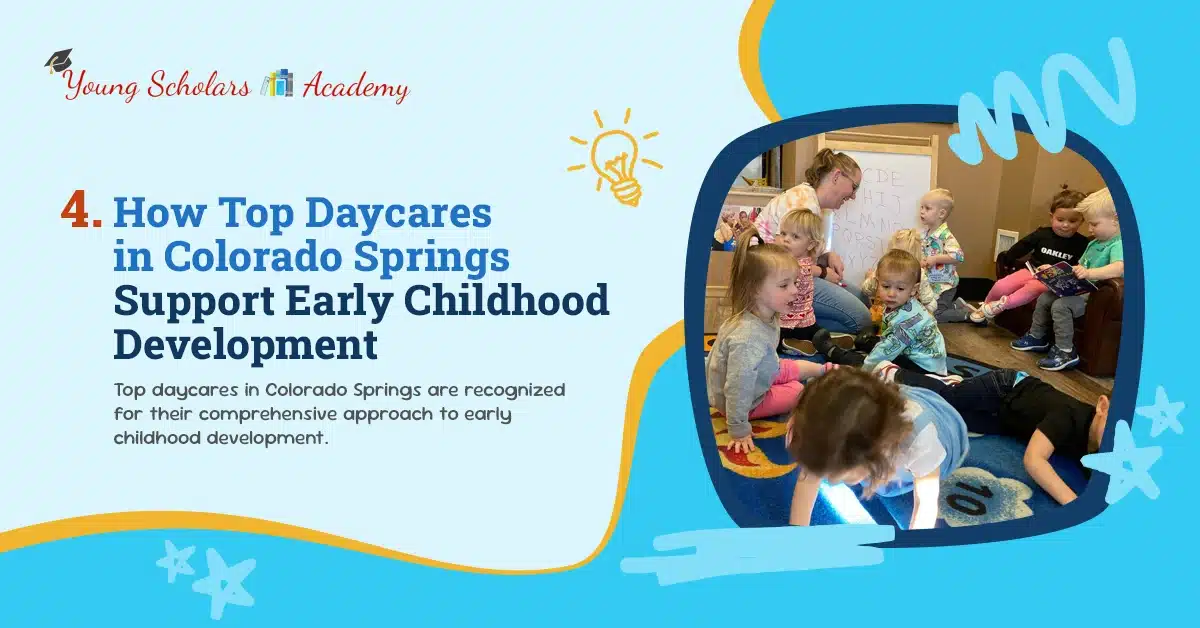
4. How Top Daycares in Colorado Springs Support Early Childhood Development

How Top Daycares in Colorado Springs Support Early Childhood Development

Top daycares in Colorado Springs are recognized for their comprehensive approach to early childhood development. These centers focus on cognitively, socially, emotionally, and physically nurturing the whole child through structured programs, intentional interactions, and consistent routines. Their efforts are grounded in research-based practices that promote long-term success.

Developmentally Appropriate Curriculum

A strong curriculum supports children’s growth by introducing age-appropriate skills and fostering curiosity. The best programs offer intentional learning opportunities through play and guided instruction.

  • Skill-based learning goals: Activities target milestones in language, math, motor skills, and problem-solving.
  • Hands-on experiences: Children learn through discovery, manipulation, and observation.
  • Individualized learning paths: Teachers adapt plans to meet the pace and needs of each child.

This structured yet flexible approach helps children build confidence and prepare for future academic environments.

Focus on Social and Emotional Growth

Emotional well-being and social interaction are key components of early development. Leading daycares create environments where children feel safe expressing themselves and building positive relationships.

  • Emotion identification and regulation: Children learn to recognize and manage their feelings.
  • Group collaboration: Activities promote sharing, cooperation, and communication.
  • Positive behavior modeling: Staff demonstrate respectful, inclusive behavior at all times.

These strategies equip children with interpersonal skills essential for success in school and life.

Health and Physical Development

Physical development is supported through daily routines that incorporate movement, nutrition, and hygiene. Quality daycares encourage active play while promoting healthy habits.

  • Daily outdoor time: Children play running, climbing, and gross motor games.
  • Nutritious meal planning: Balanced meals and snacks support energy and focus.
  • Hygiene education: Routines teach handwashing and self-care skills.

Through a well-rounded approach, top daycares create a foundation for lifelong learning and healthy development.

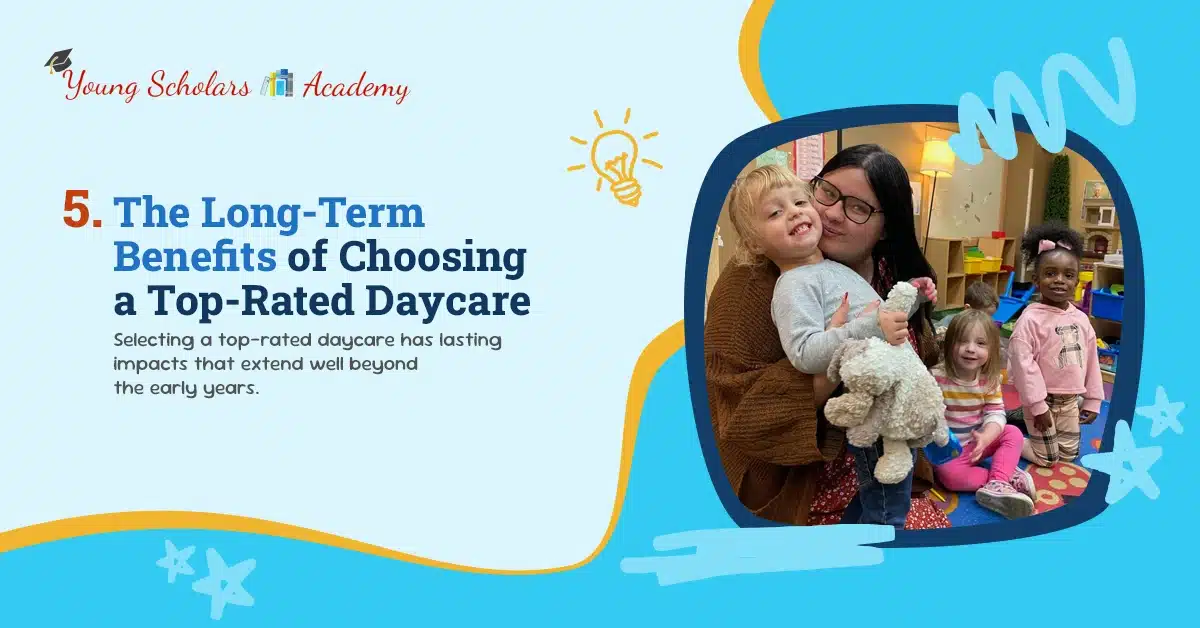
5. The Long-Term Benefits of Choosing a Top-Rated Daycare

The Long-Term Benefits of Choosing a Top-Rated Daycare

Selecting a top-rated daycare has lasting impacts that extend well beyond the early years. High-quality childcare programs do more than meet daily needs—they lay the groundwork for lifelong academic, social, and emotional success. Families who invest in trusted providers benefit from consistent developmental support and a strong educational foundation.

Enhanced School Readiness

Children who attend top-rated daycares are better prepared for the expectations of formal schooling. These programs emphasize critical early learning skills in an engaging and age-appropriate manner.

  • Pre-literacy and numeracy exposure: Early reading and counting activities build foundational knowledge.
  • Listening and attention development: Structured routines foster focus and task completion.
  • Classroom behavior familiarity: Children learn to follow directions, take turns, and collaborate.

When children enter kindergarten, they often demonstrate stronger academic readiness and adaptability.

Stronger Social and Communication Skills

Daycare environments offer daily opportunities for children to practice meaningful social interactions. Skilled educators guide children in navigating group dynamics and expressing themselves clearly.

  • Cooperative play experiences: Group activities teach negotiation, empathy, and sharing.
  • Language development: Frequent conversation enhances vocabulary and verbal skills.
  • Conflict resolution practice: Children learn to manage disagreements in a supportive setting.

These interactions help children develop emotional intelligence and positive peer relationships early on.

Greater Confidence and Independence

Top-rated programs foster a sense of autonomy and achievement through consistent encouragement and developmentally appropriate challenges.

  • Self-help routines: Children learn to dress, clean up, and manage personal belongings.
  • Decision-making opportunities: Children choose activities, solve problems, and take responsibility.
  • Supportive reinforcement: Educators recognize efforts and guide children through setbacks.

This early independence supports resilience, initiative, and a strong sense of self, benefiting children throughout their educational journey.

Conclusion

Choosing the proper daycare is one of the most important decisions a parent can make—and in Colorado Springs, the advantages of selecting a top-rated center are clear. From trusted safety practices and qualified educators to enriching curriculum and lifelong developmental benefits, top daycares provide the foundation children need to thrive. Families who prioritize quality care invest in more than daily routines—they’re building the path toward a confident, capable, and well-prepared future for their child.

Discover how the right start can make all the difference. Contact Young Scholars Academy today at (719)522-9099 or visit our contact page.

Filed Under: Family Tips

10 Unforgettable Summer Camp Field Trips to Ignite Your Child’s Sense of Adventure

April 21, 2025 by Young Scholars Academy Leave a Comment

Summer camp field trips provide children enriching opportunities to explore new environments, engage with hands-on learning, and develop valuable social skills. These thoughtfully planned excursions support the overall goals of high-quality early childhood education by extending learning beyond the classroom. Whether visiting a local museum, nature reserve, or community organization, each field trip offers experiences that foster curiosity, build confidence, and encourage a lifelong love of discovery.  

At Young Scholars Academy, every outing is designed to align with developmental milestones and educational objectives, ensuring that children remain engaged, safe, and inspired. This list highlights ten impactful field trips entertaining and supporting key learning areas.

 1. Explore Nature with Outdoor Educational Trips

Outdoor educational trips are a valuable component of summer camp programming. They offer children direct exposure to the natural world while supporting physical, cognitive, and social development. These field trips provide structured opportunities for hands-on learning and exploration beyond the classroom.   

Activities often include:   

  • Guided nature hikes that introduce children to local ecosystems, flora, and fauna   
  • Visits to nature centers that offer interactive exhibits and environmental education programs   
  • Outdoor scavenger hunts that develop observation skills and encourage teamwork   

These experiences help children understand ecological relationships, develop respect for the environment, and engage with scientific concepts in real-world settings. Time spent in nature promotes emotional well-being, encourages active movement, and cultivates a sense of wonder. By participating in outdoor educational trips, children gain foundational knowledge about the natural world and build connections that support long-term environmental awareness and stewardship.

 2. Build Confidence Through Youth Adventure Programs

Youth Adventure Programs

Youth adventure programs are designed to challenge children in a supportive and structured environment, promoting self-confidence, resilience, and teamwork. These programs focus on experiential learning, where physical and mental challenges are approached through guided participation and reflection.   

Common activities include:   

  • Ropes courses and rock climbing that encourage problem-solving and perseverance   
  • Group obstacle courses that emphasize collaboration and communication   
  • Supervised zip-lining or hiking excursions that build trust and responsibility   

Participation in these field trips helps children overcome fears, set achievable goals, and celebrate accomplishments. Each activity is tailored to be age-appropriate and aligned with developmental milestones, ensuring safety and meaningful engagement. Through youth adventure programs, children learn to take initiative, support their peers, and build a strong sense of personal achievement—skills that extend well beyond the camp setting.

 3. Enrich Growth with Summer Learning Experiences

Summer learning experiences offer a meaningful way to reinforce academic concepts while keeping children engaged during the break. These field trips integrate education with hands-on exploration, helping to bridge the gap between school years and support continued cognitive development.   

Examples of impactful summer learning experiences include:   

  • Visits to science and technology museums where children can participate in interactive exhibits   
  • Art studio workshops that encourage creative expression through various mediums 
  • Explorations of historical landmarks to connect children with local and national history   

These excursions are carefully selected to align with age-appropriate learning goals while fostering curiosity, critical thinking, and creativity. Exposure to new ideas and environments supports well-rounded development and helps maintain academic progress over the summer months. Engaging in educational activities outside the classroom, children remain intellectually active and develop a broader understanding of the world.

 4. Discover Local Agriculture at Farm Visits

Local Agriculture at Farm Visits

Farm visits provide children with a direct and engaging look at agricultural life. They help them understand where food comes from and how natural resources are used responsibly. Through firsthand observation and interaction, these field trips offer meaningful lessons in sustainability, biology, and healthy living.   

Key components of farm visits often include:   

  • Touring fields and greenhouses to learn about planting, harvesting, and seasonal crops   
  • Feeding and caring for animals to understand basic animal husbandry and responsibility   
  • Participating in hands-on farming activities such as gathering eggs or planting seeds   

These experiences connect children to nature and teach them the importance of local food systems. Farm visits also introduce basic environmental concepts such as composting, water conservation, and biodiversity. By engaging with agriculture in a practical setting, children develop a sense of appreciation for the work involved in food production and its role in everyday life.

 5. Dive into Creativity with Performing Arts Outings

Performing arts outings expose children to a variety of artistic expressions, fostering creativity, cultural awareness, and an appreciation for the arts. These field trips are thoughtfully selected to engage young learners through observation and participation in professional, age-appropriate performances and workshops.   

Typical activities during performing arts outings include:   

  • Attending live theater performances that introduce storytelling through drama, music, and movement   
  • Participating in artist-led workshops focused on acting, dance, or music fundamentals   
  • Exploring backstage tours that reveal the technical aspects of production   

These experiences encourage children to explore new interests, express themselves confidently, and engage with the creative process. Exposure to the performing arts also supports language development, listening skills, and emotional understanding. By integrating arts into summer camp programming, children can develop their imagination, connect with diverse cultural forms, and experience the joy of artistic expression in a structured learning environment.

 6. Spark Curiosity at Planetariums and Science Centers

10 Unforgettable Summer Camp Field Trips to Ignite Your Child's Sense of Adventure

Visits to planetariums and science centers allow children to explore scientific concepts through immersive, interactive experiences. These environments are designed to make complex topics accessible and engaging, encouraging children to ask questions, make observations, and make conclusions based on what they discover.   

Highlights of these field trips often include:   

  • Planetarium shows that introduce astronomy, space exploration, and the solar system   
  • Hands-on science exhibits that explore physics, chemistry, and biology through interactive displays   
  • Live demonstrations or guided experiments led by educators or scientists   

These experiences deepen children’s understanding of STEM subjects while fostering a lifelong interest in science and discovery. Engaging with scientific phenomena in a real-world setting enhances problem-solving skills and reinforces classroom learning. By visiting planetariums and science centers, children develop a broader perspective of the universe and gain confidence in exploring new ideas through observation and experimentation.

 7. Promote Wellness through Aquatic Activities

Aquatic activities are essential in promoting physical health, coordination, and self-confidence among children. Summer camp field trips to supervised aquatic environments provide structured opportunities for recreational learning while reinforcing water safety and personal responsibility.   

Common aquatic experiences include:   

  • Swimming sessions at local pools or aquatic centers under certified supervision   
  • Instruction in basic water safety and swimming techniques appropriate to age and skill level   
  • Organized water games that encourage movement, cooperation, and enjoyment   

These activities support physical development through exercise while also contributing to emotional well-being by helping children overcome fears and build independence. Structured aquatic experiences allow children to practice decision-making safely, develop trust in instructors, and gain a sense of accomplishment. Incorporating water-based field trips into summer programming ensures a balanced approach to wellness, combining fun and fitness with valuable life skills.

 8. Inspire Discovery at Zoos and Aquariums

10 Unforgettable Summer Camp Field Trips to Ignite Your Child's Sense of Adventure

Field trips to zoos and aquariums provide unique opportunities for children to observe and learn about a wide variety of animals and ecosystems. These visits support key educational goals by fostering awareness of biodiversity, environmental conservation, and the interdependence of living organisms.   

Key components of these outings include:   

  • Guided tours and animal encounters that offer insights into animal behavior and habitats   
  • Educational presentations by zookeepers or marine biologists focused on conservation efforts   
  • Interactive exhibits that allow children to explore ecosystems such as rainforests, oceans, and deserts   

Experiencing wildlife firsthand encourages curiosity, empathy, and respect for the natural world. Zoos and aquariums also help children understand global environmental issues in an age-appropriate way, promoting early interest in science and sustainability. These immersive learning environments support observation skills and critical thinking, contributing to a well-rounded educational experience during the summer months.  

 9. Foster Civic Awareness with Community Service Visits

Community service visits introduce children to the importance of social responsibility and active citizenship. These field trips are designed to promote empathy, cooperation, and an understanding of how local organizations contribute to community well-being. Through structured, age-appropriate activities, children engage in meaningful service while developing a sense of purpose and connection.   

Examples of civic-focused field trips include:   

  • Visiting food banks or donation centers to help sort supplies and learn about community needs   
  • Touring local fire stations or municipal buildings to understand the roles of public service professionals   
  • Participating in park clean-ups or simple beautification projects to support local environments   

These experiences emphasize the value of helping others and encourage children to become thoughtful, contributing members of their communities. Children begin to understand their role in shaping a supportive and inclusive society by interacting with civic institutions and service organizations. Community service visits help build character, compassion, and a strong foundation for future civic engagement.

 10. Experience Culture through Local Heritage Tours

10 Unforgettable Summer Camp Field Trips to Ignite Your Child's Sense of Adventure

Local heritage tours provide children with meaningful exposure to their communities’ history, traditions, and cultural identity. These field trips foster an appreciation for diversity and deepen children’s understanding of the people and events that have shaped the world around them.   

Typical elements of local heritage tours include:   

  • Exploring historical landmarks and museums to learn about regional history and significant events   
  • Participating in cultural demonstrations or storytelling sessions that highlight local traditions and customs   
  • Engaging with artifacts, exhibits, or re-enactments to bring historical narratives to life   

These experiences support the development of cultural literacy and critical thinking by encouraging children to consider different perspectives and historical contexts. Learning about local heritage enhances a child’s sense of place and belonging while reinforcing values such as respect and curiosity. By participating in heritage tours, children connect past and present, building awareness that enriches their educational and personal growth.

Conclusion

Summer camp field trips are more than just exciting excursions—they are thoughtfully designed experiences that enrich learning, foster growth, and ignite a child’s sense of adventure. From exploring nature and engaging in the arts to discovering local culture and contributing to the community, each trip plays a vital role in shaping confident, curious, and compassionate young learners. These outings provide children with opportunities to apply classroom knowledge in real-world settings, develop essential life skills, and create lasting memories. At Young Scholars Academy, field trips are integral to our commitment to whole-child development and meaningful summer enrichment.   

Ready to give your child a summer filled with discovery and growth? Contact Young Scholars Academy today at https://youngscholarsacademycolorado.com/contact-us/ or call (719) 522-9099 to learn more about our summer camp offerings.

Filed Under: Activities

Discover the Benefits of Enrolling in a Pre Preschool Program

April 3, 2025 by Young Scholars Academy Leave a Comment

Enrolling your child in a pre preschool program can be a transformative step in their early development. At this crucial stage, little learners thrive in an environment designed to spark curiosity, encourage social connections, and build foundational skills that set them up for lifelong success.  

A high-quality pre-preschool program offers more than just structured play—it nurtures emotional growth, enhances communication abilities, and fosters a love for learning in a safe, supportive setting. With hands-on activities, compassionate teachers, and an emphasis on discovery, these programs help your child develop essential skills while making joyful memories.

How Early Childhood Education Shapes a Strong Foundation

Early Childhood Education

The early years of a child’s life are filled with discovery, curiosity, and rapid development. Early childhood education significantly shapes their cognitive, social, and emotional skills, providing the building blocks for future learning. By engaging in structured play and hands-on experiences, children develop essential abilities that set them up for long-term success. 

Cognitive Growth: Stimulating Learning Through Play

A child’s brain develops at an unbelievable rate during their early years, making this the perfect time to introduce engaging activities that strengthen problem-solving and critical-thinking skills. Learning through play helps young minds absorb information while having fun.   

  • Encouraging problem-solving: Simple puzzles and building blocks challenge children to think critically and develop solutions.  
  • Boosting memory retention: Songs, rhymes, and interactive storytelling enhance recall and language development.  
  • Introducing early math and literacy: Recognizing numbers, shapes, and letters lays the groundwork for future academic success.  

When children engage in structured activities, they absorb new concepts and learn how to apply them in different scenarios, setting a solid foundation for continued education.

Social-Emotional Development: Learning to Connect with Others  

Building strong social-emotional skills at an early age helps children develop empathy, communication abilities, and emotional resilience. They learn to interact with peers, express their feelings, and build meaningful relationships in a nurturing environment.   

  • Practicing teamwork: Group activities and cooperative games teach children to share, take turns, and collaborate.  
  • Expressing emotions: Storytime and role-playing help children identify and communicate their feelings healthily.  
  • Building self-confidence: Positive reinforcement and encouragement from teachers create a safe space for self-expression.  

Children develop social awareness and emotional intelligence by participating in daily interactions and guided play, which is essential for lifelong success.

Hands-On Learning: Encouraging Creativity and Exploration

Young children thrive in environments that encourage creativity and hands-on learning. Engaging their senses through play lets them explore, experiment, and understand the world around them.   

  • Creating through art: Painting, drawing, and crafting help children express their imagination while improving fine motor skills.  
  • Exploring through movement: Dance, music, and outdoor activities enhance coordination and physical development.  
  • Engaging the senses: Sensory bins, water play, and textured materials stimulate cognitive and sensory processing.  

Providing children with interactive learning experiences fosters curiosity and excitement, helping them develop a natural love for discovery and problem-solving.

Independence and Self-Help Skills: Preparing for the Next Steps

A high-quality early childhood education program focuses on more than academics—it also teaches children essential life skills that promote independence and responsibility.   

  • Following daily routines: Structured schedules teach children responsibility and time management.  
  • Practicing self-care: Simple tasks like washing hands and putting away toys encourage independence.  
  • Making choices: Guided decision-making helps children gain confidence in their abilities.  

By mastering these fundamental skills in a supportive environment, children become more self-reliant and prepared for the following stages of learning.

The Role of a Toddler Learning Center in Early Development

Toddler Learning Center

The toddler years are a time of extreme growth and discovery. During this stage, children develop independence, improve communication skills, and explore the world around them. A toddler learning center is crucial in guiding this development by providing a structured yet nurturing environment where children can thrive. Through engaging activities and supportive educators, toddlers build the skills they need for future success.

Structured Routines: Creating a Sense of Security 

Consistency and predictability help toddlers feel safe and confident in their surroundings. A well-designed toddler learning center follows structured routines that create a comforting environment while encouraging independence.   

  • Morning greetings: Welcoming routines help toddlers transition smoothly into their day.  
  • Circle time activities: Group discussions, songs, and interactive storytelling build social and listening skills.  
  • Meal and nap schedules: Consistent eating and resting times support physical and emotional well-being.  

By following predictable routines, toddlers gain a sense of stability, making it easier for them to adapt to new experiences and develop self-regulation skills.

Language and Communication: Strengthening Expression

Toddlers are in the early stages of developing language, and a learning center provides the perfect setting for expanding their vocabulary and improving communication. Children build confidence to express themselves through conversation, music, and storytelling.   

  • Daily conversations: Teachers engage toddlers in discussions that encourage verbal expression.  
  • Interactive songs and rhymes: Music-based learning helps reinforce words, sounds, and sentence structure.  
  • Storytelling sessions: Books and puppets make language learning fun while improving comprehension.  

When rich language experiences surround children, they develop stronger communication skills essential for academic and social success.

Motor Skill Development: Enhancing Coordination and Strength  

Physical activity is a major component of early childhood learning, helping toddlers refine both fine and gross motor skills. Through hands-on activities and movement-based play, children strengthen their coordination and confidence.   

  • Building with blocks: Small movements, such as stacking and sorting, improve hand-eye coordination.  
  • Outdoor play and movement games: Running, climbing, and jumping promote physical strength and balance.  
  • Art and sensory play: Painting, drawing, and using playdough help toddlers develop fine motor control.  

By engaging in movement-based activities, toddlers enhance their ability to perform everyday tasks, from grasping a crayon to climbing stairs with confidence.

Social Development: Learning to Connect and Cooperate  

Social interactions in a toddler learning center allow children to practice critical relationship-building skills. They learn how to share, take turns, and express emotions in a supportive setting.   

  • Group playtime: Encourages cooperation and teamwork among peers.  
  • Guided problem-solving: Teachers help toddlers navigate conflicts and express feelings constructively.  
  • Positive reinforcement: Praise and encouragement build confidence in social interactions.  

With proper guidance, toddlers develop friendships, learn empathy, and understand how to engage with others respectfully and meaningfully.

Encouraging Exploration and Creativity

Toddlers are naturally curious, and a learning center fosters their creativity through hands-on exploration. Children gain confidence in their abilities by providing open-ended activities and opportunities for self-expression.   

  • Sensory experiences: Sand, water, and textured materials engage the senses and stimulate curiosity.  
  • Music and movement: Dancing and playing instruments encourage creativity and self-expression.  
  • Pretend play and role-playing: Dress-up and storytelling nurture imagination and problem-solving skills.  

Encouraging toddlers to explore their interests through creative play helps them develop a love for learning and a strong sense of self.

Pre-Kindergarten Readiness: Setting the Stage for Future Success

As children approach pre-kindergarten, they develop the essential skills and techniques to prepare them for a structured learning environment. Pre-kindergarten readiness focuses on building confidence, independence, and foundational academic skills, ensuring that children transition smoothly into formal education. A well-rounded pre-preschool program supports this development through engaging activities, nurturing guidance, and a balance of structured learning and play.

Early Literacy and Numeracy: Building Academic Foundations

Introducing pre-kindergarteners to letters, numbers, and basic problem-solving skills helps them gain familiarity with academic concepts. By engaging in hands-on learning experiences, children develop the confidence to explore new ideas.   

  • Letter recognition: Exposure to alphabet songs, flashcards, and storytelling strengthens early literacy skills.  
  • Counting and number concepts: Engaging activities, such as counting objects or sorting shapes, introduce basic math skills.  
  • Fine motor development: Tracing letters, using scissors, and practicing pencil grip prepare children for writing.  

Through playful learning experiences, children build a strong academic foundation while developing a love for discovery and exploration.

Independence and Self-Regulation: Encouraging Responsibility  

As children prepare for pre-kindergarten, fostering independence helps them feel confident in their abilities. Developing self-help skills allows them to navigate daily routines with ease.   

  • Following simple instructions: Activities that involve multi-step directions help children practice listening and problem-solving.  
  • Personal responsibility: Encouraging children to tidy up, put on their shoes, and wash their hands fosters self-sufficiency.  
  • Managing emotions: Guided activities teach children how to express feelings healthily and constructively.  

By mastering these essential skills, children enter pre-kindergarten with a sense of confidence, independence, and readiness to engage in a classroom setting.

Social and Emotional Growth: Learning to Connect with Others

Interacting with peers and teachers in a developed setting helps children gain the social skills necessary for pre-kindergarten. A strong focus on communication, cooperation, and empathy prepares children for collaborative learning.   

  • Practicing turn-taking and sharing: Group activities reinforce cooperation and patience.  
  • Building friendships: Play-based interactions encourage relationship-building and teamwork.  
  • Recognizing emotions in others: Storytelling and role-playing help children develop empathy and understanding.  

A supportive learning environment ensures that children feel comfortable expressing themselves while learning how to interact with others respectfully and meaningfully.

Physical and Cognitive Development: Preparing for an Active Learning Environment  

Children in pre-kindergarten need opportunities to strengthen both their physical coordination and problem-solving skills. Engaging in movement-based activities and hands-on exploration prepares them for structured learning.   

  • Gross motor activities: Running, jumping, and balancing exercises improve coordination and strength.  
  • Fine motor practice: Cutting, coloring, and threading beads refine hand-eye coordination.  
  • Critical thinking challenges: Simple puzzles, sorting games, and cause-and-effect activities encourage problem-solving.  

Providing children with diverse learning experiences ensures they develop the skills needed to succeed in pre-kindergarten. With a focus on academic, social, and physical growth, pre-kindergarten readiness equips children with the tools they need to take the next step in their educational journey confidently.

Conclusion

Enrolling your child in a pre-preschool program is one of the best investments you can make in the future. These early years lay the foundation for constant learning, fostering curiosity, confidence, and essential social skills. A high-quality program provides a nurturing environment where children can explore, grow, and form a love for learning through activities and play-based experiences. From early literacy and numeracy to hands-on exploration and social-emotional development, we focus on preparing little learners for a bright future.   

Are you ready to give your child the perfect head start? Schedule a tour today and discover how our pre-preschool program can help your little one thrive! Call us at (719) 522-9099 or visit us at the Young Scholars Academy Contact Page to learn more. We can’t wait to meet you and your little scholar!

Filed Under: Preschool, Programs & Curriculum

What Is Transitional Kindergarten and Is It Right for Your Child?

March 11, 2025 by Young Scholars Academy Leave a Comment

Transitional kindergarten is a valuable stepping stone for young learners who may not be ready for traditional kindergarten but are eager to begin their educational journey. Designed for children who just miss the cutoff date for kindergarten enrollment, this program bridges the gap between preschool and kindergarten by focusing on social-emotional growth, early literacy, and foundational math skills.  

At Young Scholars Academy, we understand that every child develops at their own pace, and transitional kindergarten provides a nurturing, structured environment where they can build confidence and independence. But is it the right choice for your child? Understanding its benefits, curriculum, and how it prepares little learners for long-term academic success can help you decide.  

Understanding Transitional Kindergarten Meaning

Transitional Kindergarten Meaning

Transitional kindergarten meaning goes beyond simply being an extra year of preschool—it serves as a critical bridge between childhood education and formal schooling. Designed specifically for children who just miss the kindergarten age cutoff, transitional kindergarten (TK) provides a structured, developmentally appropriate learning environment that nurtures academic and social skills.

Definition of Transitional Kindergarten

Transitional kindergarten is a specialized early education program for children who turn five just after the kindergarten entry deadline. It offers a unique curriculum that combines elements of preschool and traditional kindergarten, ensuring children build the foundational skills needed for success in elementary school.   

Key aspects of transitional kindergarten include:   

  • A play-based and structured curriculum: Encourages learning through hands-on activities and guided instruction.  
  • Focus on social-emotional development: Helps children build confidence, independence, and communication skills.  
  • Introduction to academic fundamentals: Lays the groundwork for early literacy, math, and problem-solving skills.  

Rather than rushing into kindergarten before they are ready, children in TK get an extra year to develop at their own pace in a nurturing environment.

Who Qualifies for Transitional Kindergarten?

While traditional kindergarten requires children to be five years old by a specific cutoff date, transitional kindergarten serves those who turn five shortly after that deadline. Eligibility may vary depending on state regulations, but generally, TK is designed for children who:   

  • Miss the kindergarten cutoff date: Typically born in late summer or early fall.  
  • Additional developmental support: Benefits children who need more time to develop emotional, social, or academic readiness.  
  • Show an eagerness to learn but are not ready for full-day kindergarten: Some children may thrive in an environment that balances structured learning with play.  

Since transitional kindergarten is often offered in public schools, enrollment criteria may depend on local school district policies. Some private and independent schools also offer TK programs with additional flexibility in age requirements.

Key Differences Between Preschool, TK, and Kindergarten 

While transitional kindergarten may seem similar to preschool and traditional kindergarten, it serves a unique role in early education. Here’s how they compare:   

Preschool:   

  • Typically for children ages 3-4.  
  • Play-based learning with a focus on basic social and motor skills.  
  • Less structured academic instruction.  

Transitional Kindergarten:   

  • Specifically for children who turn five just after the kindergarten cutoff.  
  • A balance between play and academic readiness.  
  • More structured curriculum than preschool, but with a gentler approach than kindergarten.  

Kindergarten:   

  • Designed for children five and older.  
  • More structured learning environment with clear academic expectations.  
  • Focuses on reading, writing, and math fundamentals.  

By understanding the meaning of transitional kindergarten, parents can make informed decisions about whether TK is the right fit for their child. This extra year can give children the confidence, skills, and social development to transition smoothly into kindergarten and beyond.

How Transition Kindergarten Supports Early Development

Transition Kindergarten

Transition kindergarten is designed to help young learners grow emotionally, socially, and academically before entering a traditional kindergarten setting. A structured yet flexible learning environment allows children to gain skills at their own pace. From building confidence to strengthening early academic foundations, TK provides the support children need to transition smoothly into elementary school.

Encouraging Social and Emotional Growth

Children are still learning to express themselves, interact with others, and navigate structured environments at this stage. Transition kindergarten focuses on developing these critical skills through guided activities and teacher support. With a strong emphasis on emotional well-being, children gain the tools to handle new experiences confidently.   

  • Building independence: Children learn to follow simple routines, complete small tasks independently, and make decisions.  
  • Enhancing communication: Group discussions and storytelling help improve verbal skills and active listening.  
  • Developing emotional regulation: Teachers guide children in understanding and expressing their feelings in healthy ways.  
  • Encouraging positive relationships: Collaborative play and group projects foster teamwork, empathy, and problem-solving skills.  

With these skills in place, children feel more secure in a classroom setting and are better prepared for the structured environment of kindergarten.

Laying the Foundation for Academic Success

While TK is not as academically intensive as traditional kindergarten, it introduces fundamental concepts naturally and engagingly. Children begin to explore early literacy and math skills through interactive learning, setting the stage for future academic growth.   

  • Early literacy exposure: Storytelling, letter recognition, and phonemic awareness activities help develop pre-reading skills.  
  • Hands-on math concepts: Counting, pattern recognition, and basic problem-solving exercises introduce foundational math skills.  
  • Fine motor skill development: Activities like cutting, tracing, and drawing improve coordination needed for writing.  
  • Cognitive skill-building: Puzzles, matching games, and memory exercises enhance problem-solving and critical thinking.  

These learning experiences encourage curiosity and confidence, making the transition to a more structured academic setting smoother for young learners.

Supporting Learning Through Play and Exploration

Play is one of the most effective ways for children to learn, and transition kindergarten incorporates hands-on, movement-based activities to keep learning fun and engaging. This approach allows children to absorb new concepts while staying active and engaged.   

  • Sensory-rich activities: Exploring textures, colors, and materials through art and science projects enhances cognitive development.  
  • Music and movement: Singing, dancing, and rhythm exercises strengthen memory, coordination, and social skills.  
  • Imaginative play: Role-playing activities encourage creativity while supporting language and problem-solving skills.  
  • Outdoor exploration: Nature walks, gardening, and playground activities provide physical and sensory learning opportunities.  

By combining structured learning with playful exploration, transition kindergarten ensures children develop essential skills enjoyably and naturally.

Finding the Right Transitional Kindergarten Near Me

Transitional Kindergarten Near Me

Choosing the right transitional kindergarten near me is an important decision that can shape your child’s early learning experience. With so many options available, parents often wonder how to find the best program that fits their child’s needs. From class size to curriculum, several factors play a role in selecting a high-quality TK program. Knowing what to look for can help you feel confident in your choice.

Key Factors to Consider When Choosing a Transitional Kindergarten

Not all transitional kindergarten programs are the same, so evaluating different aspects is essential before deciding. A well-structured TK program should provide a balanced mix of academics, social development, and hands-on learning.   

  • Class size and student-to-teacher ratio: Smaller class sizes provide for more individualized attention and personalized learning.  
  • Curriculum and teaching methods: Look for a program that blends play-based learning with early academic concepts.  
  • Teacher experience and credentials: Certified educators with experience in early childhood development are essential.  
  • Classroom environment: A welcoming, safe, and engaging space encourages confidence and participation.  

Visiting a school and observing these elements firsthand can give you a better sense of whether the program fits your child.

The Importance of Visiting and Researching Local TK Programs

Once you’ve identified a few transitional kindergarten programs in your area, the next step is to visit them and ask the right questions. Seeing the classroom, meeting teachers, and understanding the daily routine can deliver valuable insight into the learning environment.   

  • Observe classroom interactions: Notice how teachers engage with students and how children respond to activities.  
  • Ask about the daily schedule: Understanding the structure of the day helps determine if it aligns with your child’s needs.  
  • Look for play-based learning: Guided instruction and hands-on activities ensure a well-rounded experience.  
  • Check safety measures and cleanliness: A secure and hygienic environment is crucial for your child’s well-being.  

Researching and visiting different TK programs will help you feel more confident in selecting the best one for your child.

Questions to Ask When Choosing a Transitional Kindergarten

Asking the appropriate questions can help you evaluate whether a TK program aligns with your expectations. Consider discussing these topics with school administrators and teachers to understand better what the program offers.   

  • What is the teaching philosophy? Learn whether the program focuses on structured learning, play-based methods, or a combination of both.  
  • How does the program prepare children for kindergarten? A good TK program should build academic, social, and emotional readiness.  
  • What are the teacher’s qualifications and experience? Experienced educators with early childhood training make a significant difference.  
  • How do teachers handle different learning styles? A quality TK program should provide personalized support for varying developmental needs.  

By asking these questions, you can see whether the program fits your child’s learning style and personality. With careful research, school visits, and the right questions, you can confidently choose a program that prepares your child for long-term success.  

Conclusion

Transitional kindergarten is more than just an extra school year—it’s a chance for young learners to build confidence, independence, and a strong academic foundation in a nurturing environment. By focusing on social-emotional growth, early literacy, and hands-on learning, TK helps children transition smoothly into kindergarten and beyond. With the right program, your child can develop a love for learning while gaining the skills they need to succeed.   

If you’re looking for a supportive and engaging transitional kindergarten, Young Scholars Academy is here to help! Our experienced teachers, play-based curriculum, and welcoming atmosphere make learning fun and meaningful for every child. Contact us today to learn more about our program and schedule a visit! Call us at (719) 522-9099 or visit our contact page to get started!

Filed Under: Activities

  • « Previous Page
  • 1
  • 2
  • 3
  • 4
  • …
  • 75
  • Next Page »

CHECK AVAILABILITY

Photo of Best Childcare School

Young Scholars Academy
5815 Tutt Center Point
Colorado Springs, CO 80922
(719) 626-9650
Mon - Fri 6:00am - 6:00pm

DRIVING DIRECTIONS

Follow Us

Summer Camp Signup!
Programs
Review Us Online

Categories

  • Activities
  • After School
  • Art Projects
  • Calendar
  • Events
  • Family Tips
  • General Updates
  • Health & Wellness
  • Holidays
  • Newsletters
  • Pre-Kindergarten
  • Preschool
  • Programs & Curriculum
  • Email Login
  • Disclosures
  • Site Map
  • No Joke Childcare
  • Admin Login
  • Contact Us
  • Updates Simplified

5815 Tutt Center Point Colorado Springs, CO 80922, (719)522-9099

Copyright 2026 Young Scholars Academy All Rights Reserved.

Email Login| Site Map| No Joke Marketing For Childcare| Contact Us| Updates Simplified